Watch the 4-minute video

4:28 · English · Fictional examples. The video loads from YouTube only when you press play. Watch on YouTube
An MSL performance review should explain whether scientific work is reaching the intended stakeholders, meeting agreed quality expectations and producing useful follow up. Meeting counts can describe workload. They need a defined purpose and context before they can support a decision about performance.
This article introduces a practical set of measures and a companion MSL KPI Definition Workbook. The workbook records definitions, verified aggregate counts, target comparisons and review decisions. Its six examples and numerical targets are proposed planning choices. They are not industry benchmarks or a validated employee assessment system.
Choose the question before the indicator
Begin with a medical objective. If the team needs to understand a local evidence gap, ask which perspectives are needed, whether discussions address the question and whether the resulting evidence needs receive a review decision. Choose measures that help answer those questions. An indicator that cannot influence a useful review decision may add reporting work without clarifying progress.
MAPS guidance recommends aligning Field Medical measures with the medical plan and combining quantitative information with qualitative assessment. It also recognises that useful measures vary by organisational and therapeutic context. [1] The aim is a considered set of indicators, not a universal quota.
Use measures with different purposes
| Measure group | Useful question | Interpretation limit |
|---|---|---|
| Activity | What scientific work was completed? | Volume alone does not establish quality. |
| Coverage | Which agreed perspectives were reached? | Reach does not establish representative sampling. |
| Quality | Did reviewed work meet agreed criteria? | A review sample may not represent all work. |
| Follow up | Were commitments and decisions completed? | Closure does not prove scientific usefulness. |
| Documented outcome | What changed in a plan or decision? | A deliverable does not prove patient benefit. |
Keep the medical purpose independent
The APPA, IFAPP, MAPS and MSLS position statement describes scientific exchange, evidence generation support and insight gathering as MSL responsibilities. It specifies independence from prescription and sales targets. [2] A customer-facing medical review should therefore focus on scientific work and its evidence, rather than reward favourable opinions or prescribing intent.
Make each definition reproducible
A title such as stakeholder coverage is insufficient. Two teams can use the same title while counting different populations, dates or interactions. The Definitions tab asks for the medical objective, numerator, denominator, unit, target direction, rationale, source method, owner, review frequency, exclusions and interpretation limits.
Specify the counting unit
For completed engagements, decide whether one meeting with several participants counts as one engagement or several individual contacts. Record that choice and keep it consistent. The workbook example counts one completed engagement once. It excludes planned, cancelled and duplicate records, and requires a scientific objective, actual date and documented learning in the source log.
Match numerator and denominator
The coverage example divides distinct eligible priority stakeholders with at least one valid completed engagement by the distinct stakeholders in the agreed priority list for the period. Repeat meetings with one person do not add distinct coverage. Fix the list or document how eligibility changes are handled. A smaller denominator can increase the percentage without any additional engagement.
For timeliness, the denominator includes all eligible commitments due in the period, including those still open. Restricting it to completed commitments would hide outstanding work. The numerator includes only those completed on or before their due date. The workbook receives these verified counts from a source report; it does not calculate them from raw engagement or action records.
Define quality before reviewing it
The proposed quality example asks whether a reviewed engagement has a documented scientific objective, balanced evidence, clear limitations and appropriate follow up. Agree the criteria, sample selection and reviewer interpretation locally. A checklist applied inconsistently will create differences in reported performance that may reflect the reviewer rather than the work.
Record both the numerator and the reviewed sample size. An 80% result from ten reviewed records is eight records meeting the agreed criteria. It does not mean that 80% of every engagement was assessed or that the criteria are scientifically validated. Keep qualitative feedback available beside the rate.
Agree targets with their rationale
Base a local target on the objective, capacity, territory and evidence of what is feasible. The fictional targets in the workbook can be replaced. Count targets are numbers; proportion targets are entered as decimals such as 0.75 for 75%. Higher and Lower indicate the comparison direction. None is available for a descriptive measure without a numerical target.
CDC’s general evaluation framework emphasises context, focused evaluation questions, credible evidence, supported conclusions and action on findings. [3] These principles support a careful review process; they are not a prescribed MSL scorecard or evidence for a specific numerical target.
Interpret a fictional monthly review
The Results tab contains six invented records for Fictional MSL A for 1–30 September 2026. Counts and source IDs are illustrative. The chart compares four proportions with their fictional targets. It does not combine them into a ranking.
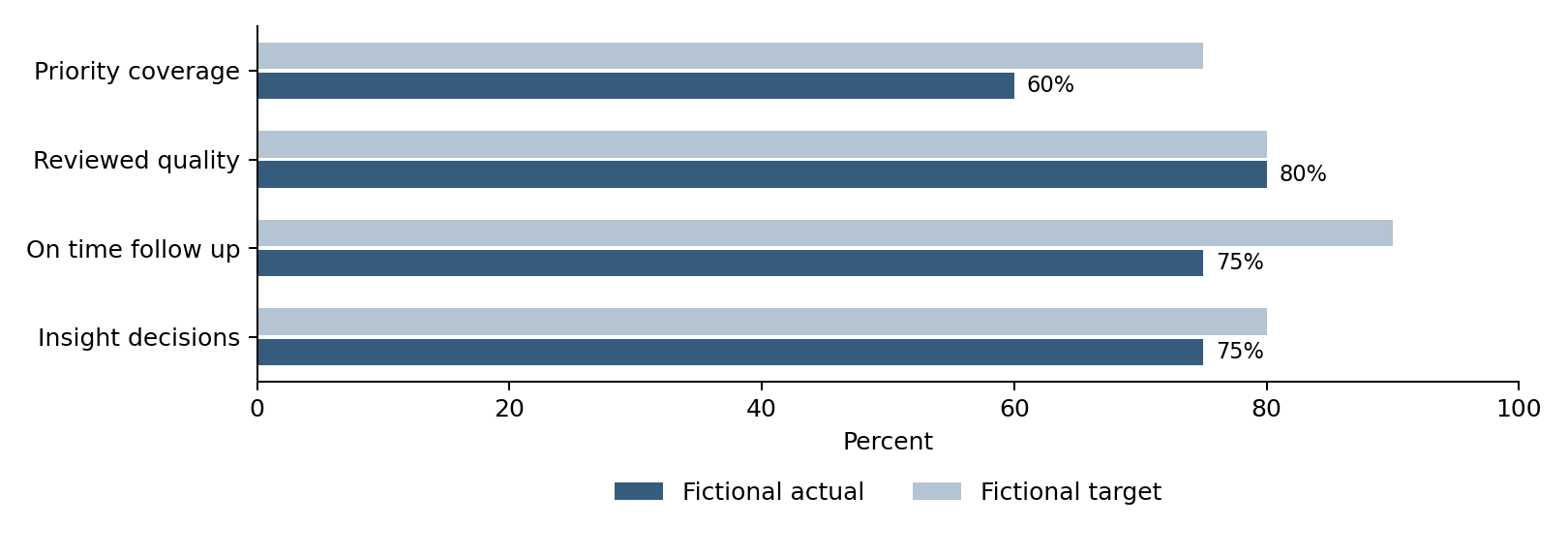
Figure 1. Invented example from the companion workbook. These measures have different denominators and should be interpreted separately.
| Example result | Evidence needed for the review |
|---|---|
| 24 completed engagements against a target of 25 | Understand capacity, preparation and scientific purpose before treating the difference as a performance issue. |
| 12 of 20 priority stakeholders covered | Review which perspectives remain unengaged. Confirm unique IDs and the agreed list. |
| 8 of 10 reviewed engagements meet criteria | Examine the two reviewed records needing improvement and the sampling method. |
| 9 of 12 commitments completed on time | Review the three commitments not completed on time and the required follow-up process. |
| 6 of 8 insights have review decisions | Review two pending records. A justified no-action decision can count as reviewed. |
| 2 evidence questions added to an agreed plan | Describe the planning contribution. Do not infer resolution of the underlying gap. |
Use the result to agree support
The discussion should produce a specific decision: adjust the engagement plan, clarify a counting rule, coach scientific discussion or remove an obstacle to timely follow up. Review responsibility as well as the number. An insight waiting for a manager’s decision should not be attributed automatically to an MSL’s lack of effort.
Use the workbook without losing context
Set up definitions before entering results
The workbook has Results, Definitions and Guide tabs. Start by agreeing the definitions and example targets, then enter verified aggregate data on Results with a unique Result ID and the correct KPI ID. Each result needs dates, the subject or team, country, therapy, source evidence reference, context and a review decision.
Country and therapy fields are free text. The workbook prepares 100 definitions and 200 result rows. All cells are editable. Amber cells are inputs and grey cells hold formulas. Overwriting a grey cell removes its calculation. There are no macros, automatic CRM imports or composite performance scores.
Distinguish missing data from zero
For a Count measure, a recorded zero is a valid numerical result. For a Proportion, a missing denominator is flagged. Zero divided by zero displays No eligible records, while a numerator greater than its denominator displays Check counts. These conditions require a source review rather than a favourable or unfavourable performance conclusion.
The target comparison is arithmetic. Meets target does not certify scientific quality or clinical benefit. A blank target displays No target agreed for a numerical comparison; direction None displays Descriptive only. The record check identifies selected omissions and invalid relationships, but it cannot validate the underlying source evidence.
Preserve the basis of historical reporting
Results looks up the current definition, unit, direction and target by KPI ID. Changing a definition will update all linked rows. If a target or definition changes for future periods, create a new KPI ID and retain the old definition so historical results keep their agreed basis. Keep a controlled copy and approved source records.
Compare like with like
Consider geography, stakeholder availability, product lifecycle, tenure, leave, training, scientific preparation and responsibilities before comparing people or territories. Do not sum monthly coverage percentages to obtain quarterly coverage. Recalculate distinct coverage over the whole quarter from the source population. Likewise, use summed matching numerators and denominators for compatible rates, except distinct-count measures such as coverage, rather than average percentages with different sample sizes.
Review the evidence behind selected records
• Check that the source population and period match the definition.
• Inspect a sample of documented scientific work alongside quantitative results.
• Discuss limitations and alternative explanations for differences.
• Record the decision, follow-up owner and due date where action is needed.
• Revisit whether the measures remain useful for the medical objective.
The approved Stakeholder Strategy and Engagement System and Insights Tracker can provide relevant source records. This KPI workbook does not synchronise with them. Transfer only verified aggregate counts and retain a traceable source reference.
Practical checklist and references
Before adopting a KPI
• Name the medical objective and the decision the measure will inform.
• Agree the counting unit, population, dates and exclusions.
• Define the numerator and denominator where a proportion is used.
• Agree the source method, owner, review frequency and target rationale.
• Write down what the measure cannot establish.
Before reporting a result
• Verify counts against the approved source and distinguish missing data from zero.
• Explain context, sampling and uncertainty.
• Review target comparisons alongside the documented scientific work.
• Record a proportionate decision and the follow up required.
References
1. Ortiz N, Crawford D, Kerliu-Saliu I, Goldberg E. Field Medical Metrics/KPIs Guidance Document. Medical Affairs Professional Society. Undated PDF. Sections on strategic alignment, quantitative and qualitative measures, and communication of value.
Read the MAPS guidance document
2. Theron P, Britland M, Holder D, Ikeda Y, Rewers RF, Tiku A. Promoting Best Practices for Medical Science Liaisons Position Statement from the APPA, IFAPP, MAPS and MSLS. Therapeutic Innovation & Regulatory Science. 2021;55:1139–1144. doi:10.1007/s43441-021-00310-y.
Read the professional position statement
3. Centers for Disease Control and Prevention. CDC Program Evaluation Framework. 20 August 2024. General evaluation principles and steps.
Read the CDC evaluation framework
Sources accessed 6 October 2026. Professional and general evaluation guidance support the cited principles. Workbook definitions, quality criteria and targets are proposed design choices and do not constitute a validated employee rating or clinical outcome measure.
Companion resource
MSL KPI Definition Workbook version 1.0. Catalogue ID MA-041. The fictional source counts in this article match the six demonstration records in the workbook. Adapt the definitions and targets to the intended process before use.
MSL KPI Definition Workbook
Explore the workbook, its instructions and its fictional examples before adapting it to your team.
View the matching workbook